
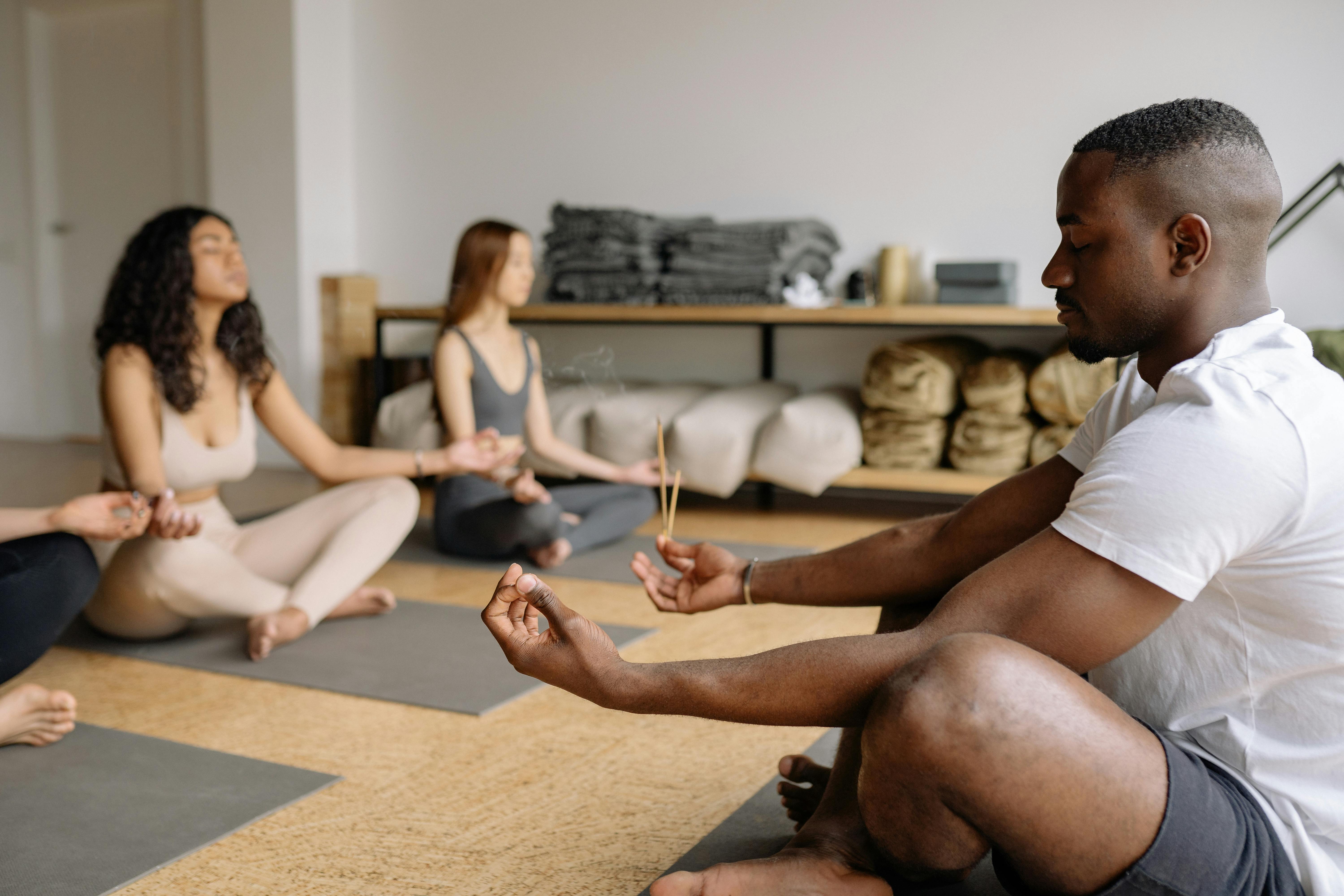
Repeating a word or phrase, continuously, as a practice, appears in Hindu, Buddhist, Christian, Islamic, Jewish and other traditions.
The independent emergence suggests the technique does something, and what it does has been examined in various ways.
The forms
Japa in Hindu traditions — repetition of a mantra, frequently counted on beads.
Nembutsu and similar in Buddhist traditions.
The Jesus Prayer in Eastern Christian practice, a short formula repeated continuously, sometimes coordinated with breathing.
Dhikr in Islamic practice, remembrance through repetition of divine names or formulae.
Rosary practice in Western Christianity, repetition with counting.
The near-universal presence of counting devices — beads, knots, cords — is worth noticing. Something about the physical count appears useful.
What the traditions say it does
Accounts vary and cluster.
Occupying the discursive mind, so that internal chatter is displaced by the repetition.
Establishing continuity, so that the practice runs beneath other activity rather than being confined to sessions.
Devotional function, where the content of the phrase matters and the repetition is an act of relationship rather than a technique.
And in several traditions, claims about the sound itself having effects independent of meaning, which is a stronger claim.
What has been examined
Research on repetitive practice has looked at several things.
Breathing effects. Repetition of phrases at a natural pace tends to regulate breathing, and studies of recited prayer and mantra have found breathing rates converging on around six breaths per minute — which is the rate associated with maximum heart rate variability.
One notable study compared recitation of a rosary formula with a yoga mantra and found both produced similar breathing rates and similar cardiovascular effects.
That's a striking finding because it suggests two unrelated traditions independently arrived at practices producing the same physiological result.
Attention. Repetition provides a continuous object, which is simpler to return to than the breath for many people.
Semantic satiation. Repeating a word many times causes it to lose apparent meaning — a well-documented psychological effect.
Some accounts propose this as part of the mechanism: the phrase becomes sound rather than meaning, which changes what attention is doing.
Reduced default mode activity. Some imaging studies of repetitive practices have found changes in networks associated with self-referential thought, though this literature is limited.
Meaning or sound
A genuine question that traditions answer differently.
Some hold that the meaning is essential and the practice is devotional. Some hold that the sound has intrinsic effect regardless of comprehension, which is why practitioners frequently recite in languages they don't speak.
The breathing research is agnostic on this — the physiological effect appears to come from the pace of recitation rather than from the content.
Which suggests that if the effect people notice is primarily relaxation and attention, the content may matter less than traditions claim. If the effect is devotional, it obviously matters entirely.
Those are different practices producing different things, and running them together confuses the discussion.
The beads
Worth a note because the near-universality is interesting.
Counting devices provide a physical anchor, tactile feedback, and a way of maintaining count without occupying attention with counting.
They also provide structure — a defined number, an end point — which converts an open-ended practice into a bounded one.
And there's a straightforward practical function: they occupy the hands, which for many people reduces restlessness.
Practical guidance
For anyone trying this outside a tradition.
Choose something you can repeat comfortably at a natural pace. Length matters — a phrase that fits an exhalation works better than one that doesn't.
Coordinate with breathing, at least initially. The traditions that specify this appear to have identified something.
Use a physical counter. It helps more than seems reasonable.
Expect the phrase to lose meaning. That's normal and appears to be part of what's happening.
And expect the mind to continue underneath. The repetition doesn't stop thought; it provides something to return to when you notice thought has taken over, which is the same operation as any attention practice.
A caution
Traditions generally attach mantra practice to a framework and a teacher, and treat the choice of phrase as significant rather than arbitrary.
Adopting a phrase from a tradition without its context is common and worth being aware of. At minimum it's worth knowing what a phrase means and what it's understood to do before repeating it many thousand times.
Repetition in secular contexts
Worth noticing that the technique appears outside religious settings in forms that are not usually recognised as related.
Counting during exercise. Repeating a phrase during a difficult physical effort. The rhythmic chants used in military training and in team sport.
Each involves sustained repetition coordinated with breathing or movement, occupying the discursive mind during effort.
Athletes and coaches describe these in terms of focus and of blocking distraction, which is a plausible description of the same mechanism arrived at independently.
Which supports the reading that the effect is largely about what repetition does to attention, rather than about anything specific to particular phrases.